
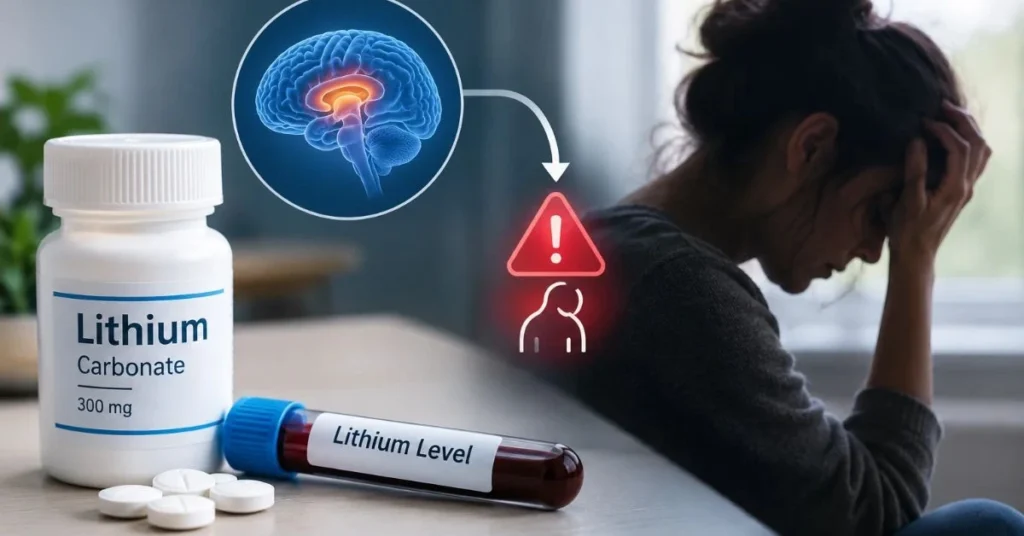

When most people hear “lithium,” they think of the medication used to treat bipolar disorder. But lithium is also an element found naturally in small amounts in drinking water and food.
A 2017 study in Psychopharmacology asked a thought-provoking question: could the tiny amounts of lithium circulating in a person’s blood be related to their risk of attempting suicide?
Why Researchers Were Curious
Lithium already has a well-known place in psychiatry. Meta-analyses have shown that lithium treatment has anti-suicidal effects, and these appear to be stronger than those of some other mood stabilizers used in bipolar disorder treatment.
Researchers have also looked at the trace amounts people absorb every day. Ecological studies have suggested that micro-doses of lithium in drinking water may protect against suicide. What was missing was individual-level data: do the blood levels of real patients line up with what happened to them?
How the Study Worked
The researchers analyzed 199 patients: 31 who had attempted suicide, 21 who had engaged in self-harm, and 147 control patients. The blood samples came from people seen at a critical care center, and the control group included patients treated for trauma.
The team made careful exclusions. People with schizophrenia were left out, since it is hard to tell whether an attempt reflects intent to die or psychotic symptoms such as hallucinations. Anyone with a past or present history of lithium therapy was also excluded, because medication would swamp the small amounts a person absorbs from water and food.
What They Found
The results showed a pattern. The three groups differed significantly, and patients who had attempted suicide had lower lithium levels than controls. This was true in men but not in women. After adjusting for age and gender, the difference remained statistically significant.
The levels involved were very small. Average concentrations were about 3.96 μg/L in the suicide attempt group, 5.01 μg/L in the self-harm group, and 5.53 μg/L in the trauma group. The authors concluded that higher serum lithium levels may be protective against suicide attempts in people who have never taken lithium therapy.
Where This Fits in the Bigger Picture
This study is one piece of a growing body of work. Later researchers have continued to compare lithium levels in different groups, including people who died by suicide and those who died of other causes. Taken together, this research suggests lithium’s role in mental health may extend beyond the medication cabinet and into diet, environment, and biology.
Important Caveats
It’s easy to over-read a study like this, so here is what it does and doesn’t show:
It shows an association, not cause and effect. Low lithium may simply be a marker of something else, such as diet, health status, or where someone lives.
It’s relatively small. Only 31 people in the study had attempted suicide, and the difference showed up in men but not women.
It does not support taking lithium supplements. Lithium is a powerful medication that requires medical supervision, including blood monitoring. Please don’t start any lithium product on your own.
What This Means for Mental Health Care
The takeaway isn’t a quick fix. Suicide risk is complex and rarely comes down to one factor. Biology, stress, trauma, relationships, sleep, substance use, and access to care all play a role. Research like this reminds us that mental and physical health are deeply connected, and that careful, whole-person evaluation matters. A functional and integrative psychiatric evaluation considers biological, psychological, and lifestyle factors that may contribute to mental health symptoms.
If you’re concerned about your own mental health or a loved one’s, a thorough conversation with a qualified provider is the best first step.
If You Need Support
If you or someone you know is struggling, call or text 988 (Suicide & Crisis Lifeline) at any time. If you’re in immediate danger, call 911.
Reference
Kanehisa, M., Terao, T., Shiotsuki, I., Kurosawa, K., Takenaka, R., Sakamoto, T., Shigemitsu, O., Ishii, N., Hatano, K., & Hirakawa, H. (2017). Serum lithium levels and suicide attempts: a case-controlled comparison in lithium therapy-naive individuals. Psychopharmacology, 234(22), 3335–3342. https://doi.org/10.1007/s00213-017-4729-z
Medically reviewed by
Stephanie Schabel, PMHNP-BC
Board-Certified Psychiatric Mental Health Nurse Practitioner
Stephanie began her career as a registered nurse, caring for surgical and cardiac patients at a leading hospital in Houston, Texas, and later worked as a travel nurse across Oregon during the COVID-19 pandemic. She completed her Psychiatric Nurse Practitioner education at Gonzaga University and is currently completing a fellowship with Psychiatry Redefined in functional and integrative psychiatry. At SKS Psychiatry, she combines evidence-based medication management with attention to sleep, nutrition, stress, and overall health, caring for adults by secure telehealth across Oregon and Washington.
This post is for educational purposes and is not medical advice.